
The Liberty Virtual Courtroom is an optional service integrated into the Liberty Court Recorder.
Courts may purchase a subscription for this service from their Liberty reseller.
A court subscribing to this service can create links and phone codes
that provide Internet-based access to remote participants accessing the courtroom.
Courtroom Setup
Prior to scheduling a remote hearings, Courts must take the following steps.
The diagram below provides an overview of the required setup.
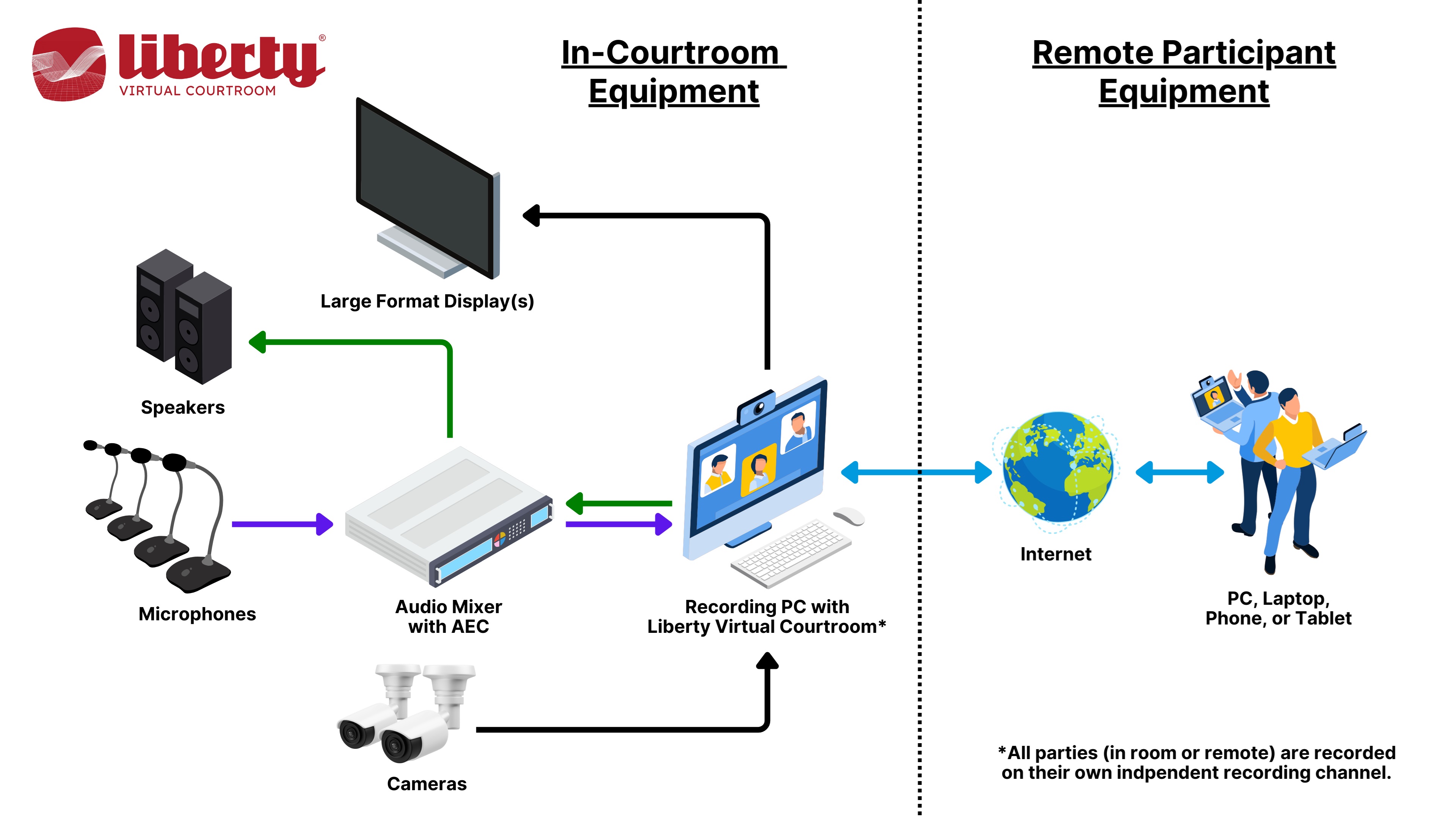
The courtroom must have a voice uplift system, commonly referred to as a DSP, and courtroom speakers to allow remote participants to be heard in the courtroom.
The DSP must send the audio from the courtroom microphones to the recording computer and it must have echo cancelling features to eliminate echo and feedback.
Courtroom cameras can be used to send video to the remote participants.
Recommended Courtroom Setup
For virtual courtroom operations, we recommend the following setup:
- A recording computer with at least an Intel i5 processor with 4 processing cores and a speed of at least 2.4GHz or faster and 16GB of internal memory.
If the optional Streaming Service is also used, then the Recording computer must have at least an Intel i7 or faster processor.
Contact your Liberty reseller or Liberty support for questions about various advanced configurations.
- An Internet connection with a speed of at least 15Mbps both up and down.
- The recording computer must have a second video output port, preferably HDMI,
which connects to a large screen monitor. This will allow persons in the courtroom to see the remote participants.
- UDP Firewall ports must be opened so the Recorder can initiate communications traffic to the conference server.
The default ports used are all UDP, port number 3479 and UDP ports 50000 to 50999.
- If a Secure Access Service Edge (SASE) security system is used by the account, such as Zscaler or Prisma (Palo Alto Networks), then all traffic
destined for the conference server should be set to "bypass" the SASE system. SASE systems are known to restrict and inhibit the transmission of audio/video traffic.
Follow this link for more details on the need for audio/video
traffic to bypass Zscaler.
- A telephone line that is directed at the conference server on the Internet to facilitate telephone calls into the virtual court, if applicable.
Implement a Voice Uplift (DSP) System
Courts must use an echo cancelling voice uplift system, commonly refered to as a DSP.
Scroll down on this page to the section entitled Supported Audio Recording DSPs for a list of DSPs widely used with the virtual court.
Configure the Recorder Application
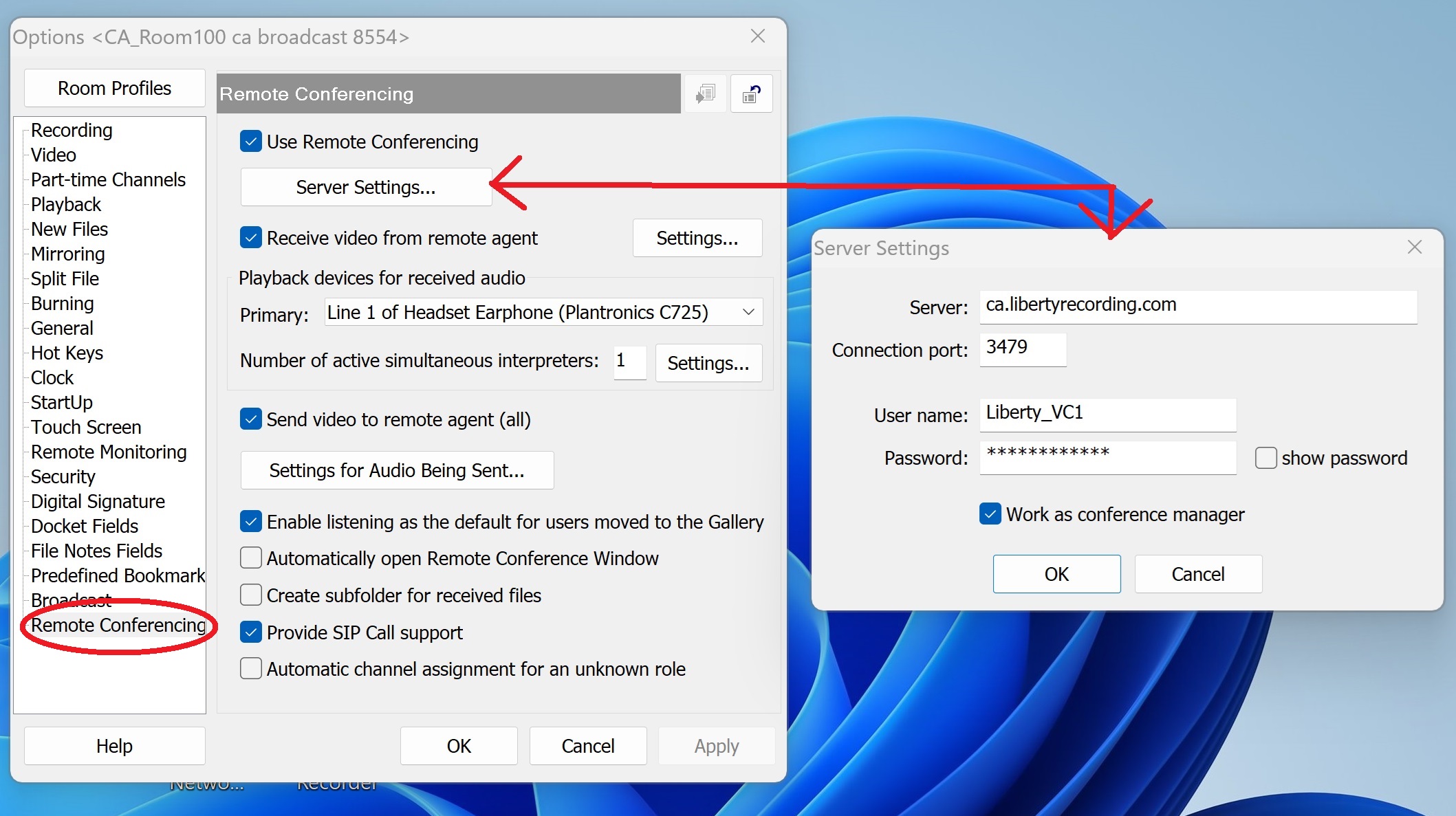
In the Recorder options, use the Remote Conferencing tab to specify the following:
- The server name of the Conference Server along with an appropriate username and password.
-
Whether the remote participants will receive video from the courtroom.
-
The audio output playback channel.
An example of the configuration is shown below.
Provide Courtroom Cameras
The Virtual Courtroom facility can send video from the courtroom to remote participants.
We strongly recommend the use of Axis brand IP cameras for capturing video in the courtroom.
Provide and connect a telephone line (PSTN) to be used by the conference system, if applicable.
The Virtual Courtroom facility can support remote participants using old-style dial telephones connecting to the conference.
Court IT staff must discuss providing and connecting such a telephone line with their local supplier.
|